

How To Repair Rails On Boat Trailer
How strong is a zilch-tie? Could ane agree the end of a bunk board carrying a two,200# sailboat for 250 miles at highway speeds, including over a mount laissez passer? Would you lot do information technology with your gunkhole? How about two, 1 on each end with a rusted bolt in the eye of the bunk?
Pretty strong as it turns out. The picture below shows the aft end of the starboard bunk just as the previous possessor had tied it before I purchased the gunkhole and towed it home. The other finish was like information technology. They held the whole way. Notice that at that place is no commodities holding the bunk to the bracket. Don't try this at habitation, kids.
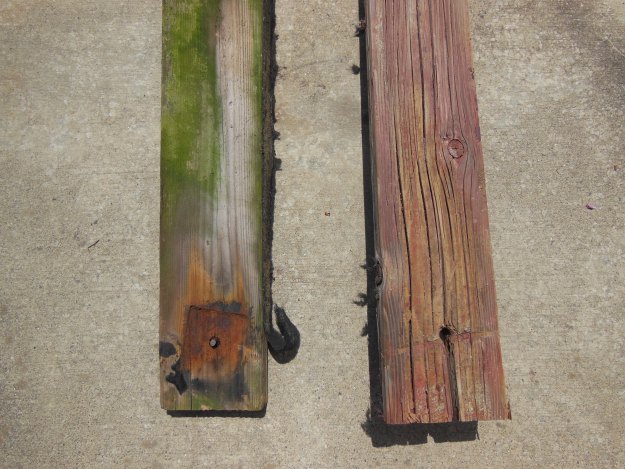
The port side bunk was in the same condition, more or less: rotted bolt holes, loose and rusted bolts, rotted bunk boards, no carpet. No wonder the bottom paint had chipped and peeled away in places. Those bunk boards needed replaced, pronto.

Raising a gunkhole on its trailer
Making new bunk boards is the easy part. The hardest part about this project is raising the boat off of the bunk boards if your gunkhole isn't already in the h2o. Information technology's actually easier than y'all think if you raise i side at a fourth dimension. The post-obit instructions work for the Trail Rite trailer originally supplied with the first generation Catalina 22 but they should also work for most other trailers every bit well.
To raise each side:
- Confirm the bow is held tightly past the trailer winch.
- If you have a swing keel, raise the keel completely off the trailer until y'all're finished replacing the bunk boards.
- Jack the entire trailer upwardly one corner at a time and support the unabridged frame on jack stands to keep it stable.
- Place two (or three if you take them) bottle or scissor jacks on top of the frame next to each eternalize bracket that supports the bunk.
- Place 1 or ii short blocks of framing lumber (2″ 10 half-dozen″ x 8″ min.) betwixt the jack and the hull to spread the load and prevent oil-canning.
- Alternately enhance each jack an inch or two at a time until the hull is about four″ above the bunks.
Removing the onetime bunks
When you have one side jacked upwardly, remove the bolts that fasten the bunk to the eternalize brackets and remove the bunk. If the fasteners are rusted and uncooperative, use a reciprocating saw with a metal bract or a hot wrench (acetylene torch) to cutting them off. In any case, discard the old fasteners and replace them with new galvanized or stainless steel fasteners so they won't be a trouble the next time or for the next owner.
Making new bunks
Buy new, pressure level treated ii×6 boards a little longer than the altitude between the ii stop bolster brackets. For instance, if your bolster brackets are over ix′ apart and less than 12′ apart, purchase 12′ long 2x6s instead of 10′ long. It's amend that the bunks are a piffling too long than barely long plenty. The extra woods volition help foreclose splitting as the bunks age. If necessary, cutting the boards down to ane′ longer on each stop than the distance between the bolster brackets.
Many trailers take their bunks attached to the bolster brackets with carriage bolts countersunk into the tiptop surfaces of the bunks (so the heads don't damage the hull) and held past lock washers and basics on the undersides of the bolster brackets.
My preference is lag bolts (5/16″) screwed into (simply not through) the bunks from underneath the bolster brackets. This method eliminates the countersinks in the tops of the bunks that hold h2o and accelerate softening and rotting. Besides, the fasteners don't need to provide compression strength; the weight of the boat does that. All they demand to provide is lateral stability.
Yous can use just about whatever textile to pad the bunks. Carpet remnants, artificial grass fabric, and discarded burn hose are popular choices. I prefer to buy traditional bunk carpet past the foot from an online source like trailerpartsdepot.com. It works well, lasts a long time, and looks amend than dumpster filler. I buy it only wide enough to wrap effectually the bunk edges and to go out the lesser of the bunks open to the air to dry faster similar in the commencement photo. Attach information technology to the bunk boards with stainless steel staples that won't rust and autumn out.
Getting the bends
Mounting the boards on the eternalize brackets correctly means putting simply the right corporeality of bend in the boards to conform to the shape of the hull before you install all the fasteners. Y'all tin can use the sailboat itself to get perfect bends.
To mount each board:
- Measure out the distance between the uttermost two commodities holes in the old bunk boards. Heart that distance on the midpoint of the new bunk board and marking the locations of the lag bolt pilot holes or through bolt holes.
- Drill a hole in only one end now.
- Place the lath on the eternalize brackets with the drilled hole aligned with its hole in the bracket. Don't worry that the other marks don't line upwards for now or that the board isn't bent plenty. You may need to set the drilled stop of the lath on its bolster bracket beginning and then manually elevator the other end of the board to get it to bend enough to slide onto the other subclass. If necessary, jack the boat up a little college until you lot can center the lath width evenly on both ends.
- Install a fastener in the first hole.
- Alternately lower the jacks completely and so that the hull presses the bunk board into the right shape and down to the middle bolster bracket if your trailer has one.
- Drill the remaining holes using the bolster brackets as guides. This ensures the holes are in the right spots. If you will install lag bolts from underneath, drill pilot holes. If you will install railroad vehicle bolts down from above, also drill airplane pilot holes now, then you'll accept to jack the boat up again to complete drilling and countersinking the holes.
- Install the two remaining bolts and you lot're done with that side.
Replacing bunk boards certainly isn't a very fun project, but considering the cost and trouble of a bottom pigment job, it's the wise option if your boards aren't doing their job.
Would y'all similar to exist notified when I publish more posts similar this? Enter your email address beneath to subscribe to this blog and receive notifications of new posts past email. You will also receive occasional newsletters with exclusive info and deals only for subscribers and the password to the Downloads page. It's complimentary and y'all tin can unsubscribe at any time simply almost nobody does!

Source: https://stingysailor.com/2020/10/10/trailer-bunk-board-replacement/
Posted by: gonzaleznathat.blogspot.com
0 Response to "How To Repair Rails On Boat Trailer"
Post a Comment